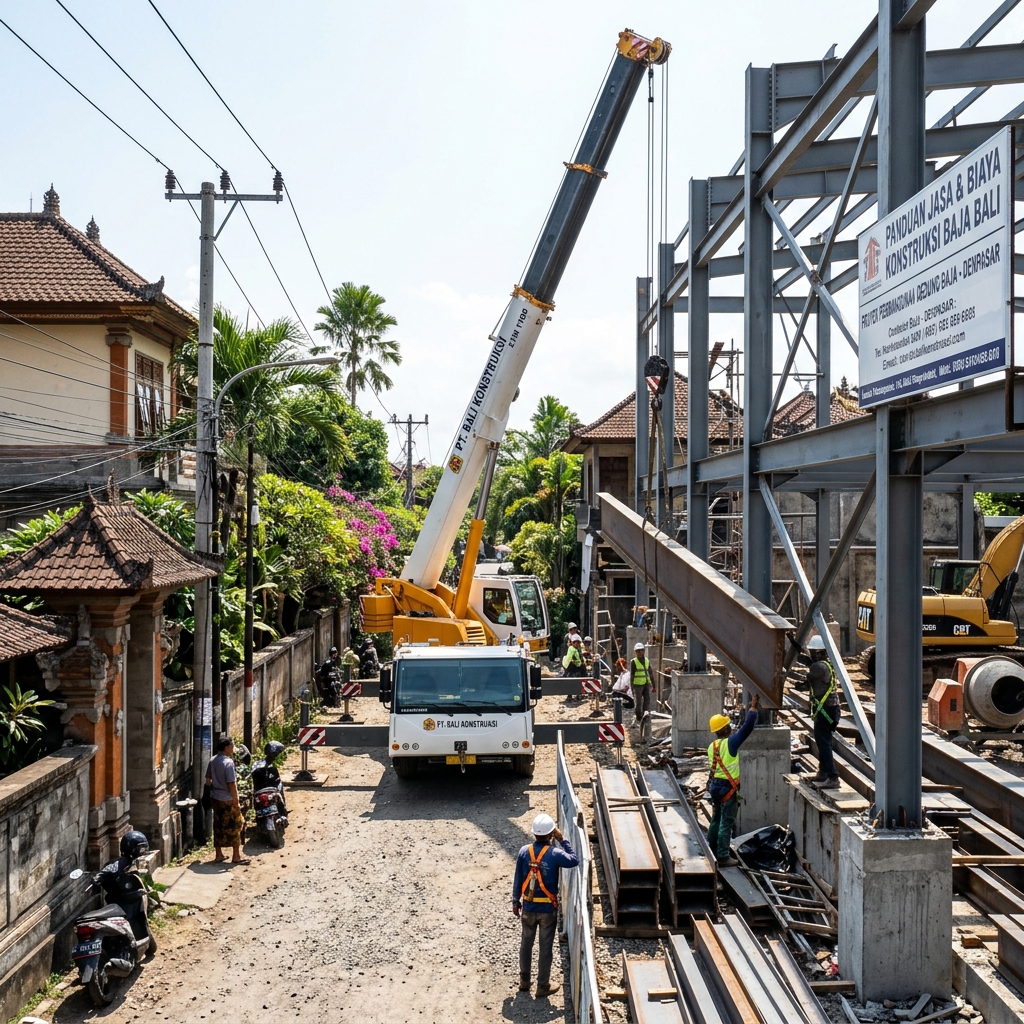
Fabrication workshop standards in Bali enforce raw material mill certificate auditing, sub-millimeter cutting tolerances, BNSP-certified structural welders, and non-destructive weld testing (NDT).
Compromising on connection gusset plate thickness (min 10 mm) or uncalibrated bolt torque risks severe structural deflection and failure to secure final occupancy certification.
Importance of Professional Fabrication Workshop Infrastructure
Structural steel integrity is predominantly established within the controlled environment of a modern fabrication workshop rather than on the job site. Industrial facilities featuring heavy-duty overhead travelling cranes, level assembly jigs, and automated profiling equipment guarantee the true squareness and camber of structural members prior to field delivery.Welder Qualifications and Certified WPS/PQR Standards
Every moment-connection weld must comply strictly with Welding Procedure Specifications (WPS) and Procedure Qualification Records (PQR) compliant with AWS D1.1 structural codes. Tukang United welders maintain formal national certifications for 3G and 4G positions, ensuring complete joint penetration free from internal porosity or undercut defects.Non-Destructive Weld Testing (NDT) Methodologies
For multi-story structures, hospitality facilities, and architectural cantilevers, rigorous Non-Destructive Testing (NDT) protocols are executed. Inspection regimes combine systematic Visual Inspection (VT), Magnetic Particle Testing (MT) for surface cracks, and Ultrasonic Testing (UT) to identify sub-surface internal discontinuities.Industrial Surface Preparation and Handover Protocols
Prior to protective coating application, structural steel surfaces undergo abrasive blast cleaning to international Sa 2.5 cleanliness standards. Industrial epoxy primer barriers are applied in climate-controlled bays and verified with digital dry-film thickness gauges before official project handover certification.Technical Standards & References:
Technical Q&A
Frequently asked structural steel questions in Bali
Can Tukang United provide third-party laboratory weld inspection reports?
Yes, for critical moments and commercial contracts, we arrange third-party Ultrasonic Testing (UT) certified by accredited national laboratories.
Why is Sa 2.5 abrasive blasting essential in coastal Bali?
Marine air carries airborne salt ions. Applying paint over hand-scraped steel without abrasive blasting leads to premature delamination and corrosion within months.
What handover dossier is provided to the building owner upon completion?
Clients receive complete As-Built Drawings, original mill test certificates, welder qualification logbooks, NDT inspection reports, and written structural warranties.
Technical Journal Exploration
Explore Related Structural Engineering Guides
Deepen your understanding of structural steel standards, precision fabrication methods, and building engineering in Bali.